In Pursuit of Artistry Beyond Intention
Born in 1944. He looks up to three men as teachers of the heart: Kuniyoshi Obara, Noriyuki Ushijima and Tatsuzo Shimaoka. After entering Tamagawa University he took the path of woodwork. He came to question the world of craft, in which technique is the purpose. Grounded in an artistry of his own, fostered by his experience and by the influence of his three teachers of the heart, he continues to work with an unprecedented approach to lacquer, toward the artistry he holds in his mind.
In Pursuit of Artistry Beyond Intention
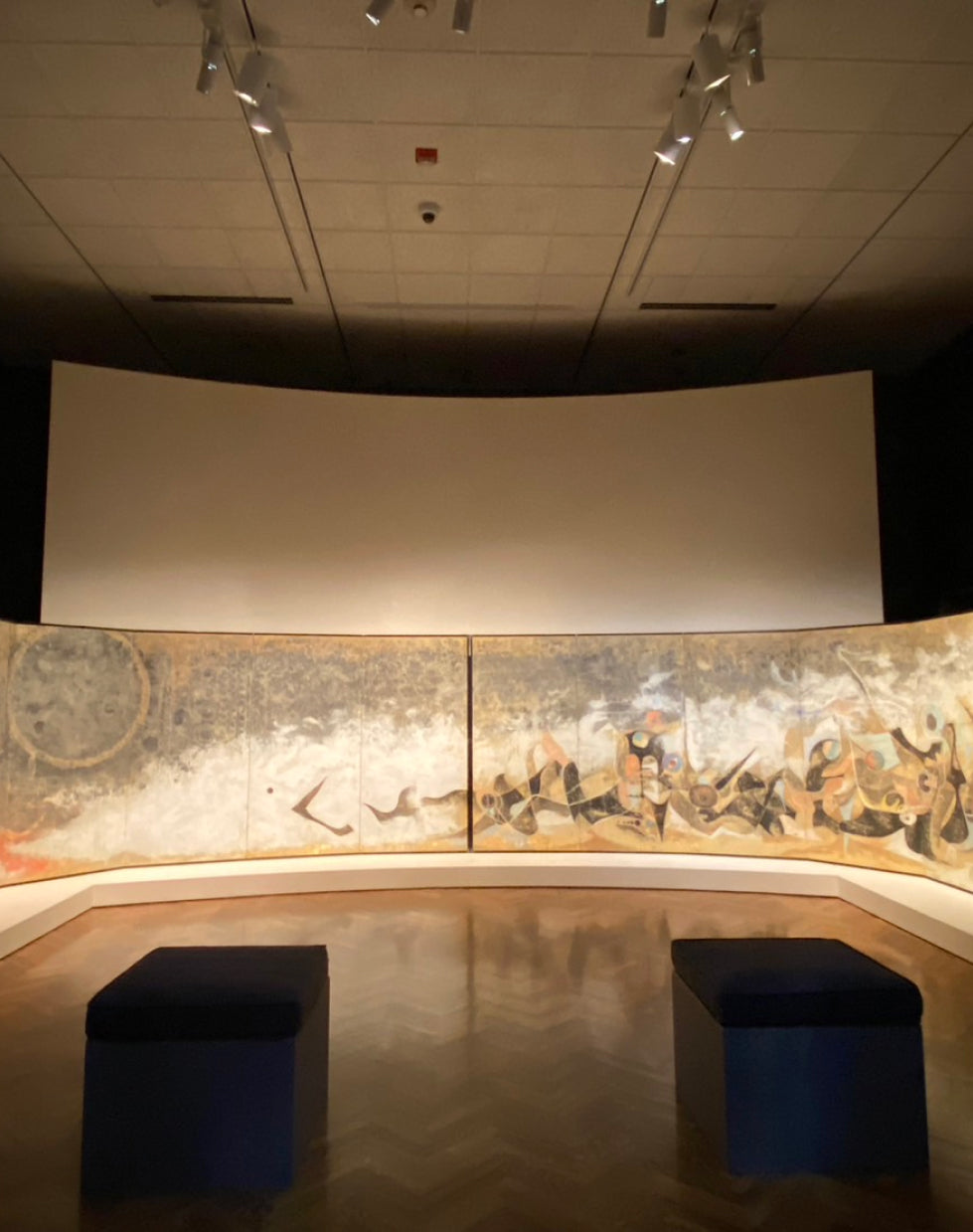
The works of Tohru Matsuzaki have a distinctive lacquer texture, roughly applied in many layers. The touch is like that of an abstract painting. These works overturn our usual idea of lacquer, with its smooth surface.

Mr. Matsuzaki's lacquer works, like other lacquer art, embody the "beauty of use," and one of their purposes is everyday use. Yet, more than that, Mr. Matsuzaki's artistry seems to rise from the work itself. His aim is for the man-made to surpass nature. As to the difference between the two, he says that the man-made is the intention and technique that arise in making, while nature is sensibility. For Mr. Matsuzaki, who questions the values of a craft world that makes technique its purpose and seeks to embody his own artistry, the idea that "the man-made surpasses nature" may seem an antithesis. But there is no contradiction in this philosophy. Technique carries many intentions. When we make something, a blueprint for it arises in the mind, and technique is applied to a single object, the future finished form (hereafter the "objective"). In much of the craft world this "objective" is clearly defined and is produced from the available choice of techniques. In other words, the "objective" presupposes the technique. In making that is strongly intentional and based on technique, therefore, the "objective" has no need to go beyond the wall of the image. By contrast, in making whose purpose is artistry, an ideal artistry that may be called a kind of aesthetics stands as the distant goal. To make is the result of seeking to express a formless aesthetics. So, while quality matters, technique and completion are secondary to the "objective" itself; what is central is the reason for expression and the artistry that lie beyond it. To fulfill the aesthetics he pursues, technique is used as the medium needed for an ideal that, in a sense, takes form from the "Idea" through the maker. Works that make technique their purpose try to speak even of the maker's inner sensibility, and intention shows; but when technique is used for the sake of artistry, sensibility comes to be expressed in a natural form.

Whether craftsperson or artist, technique and sensibility are both important; but the craftsperson works chiefly from technique, the artist chiefly from sensibility. Tohru Matsuzaki seems to stand between the two. As a craftsperson he is permitted to accommodate technique; yet as one who holds an artistic philosophy and is also an expressive artist, the purpose of his making is the fulfillment of the artistry he holds within. So, while using the techniques of woodwork and lacquer, he goes on applying layer upon layer of lacquer until the intention that arises from technique disappears. As he does so, the intention of using technique is removed and the form comes into view. At that moment technique merges with the sensibility that lies deep within him and becomes a work. Then, looking back at the work that has resulted and making again and again, Mr. Matsuzaki draws closer to the work of his formless artistry. What Tohru Matsuzaki aims at, one might say, is not the completion of a single work but the pursuit of the artistry in his mind's eye.

Tohru Matsuzaki
(1944)
Born in Umegaoka, Tokyo
(1967)
Graduated from the Faculty of Letters, Tamagawa University
(1974)
Received guidance from the ceramic artist Tatsuzo Shimaoka
(1982)
First selected for the Kokugakai Exhibition
(1983)
Kokugakai New Artist Prize; first solo exhibition at Seibu Department Store, Ikebukuro, held annually thereafter
(1984)
Became an associate member of the Kokugakai; solo exhibition at Meitetsu Department Store, Nagoya, held every other year thereafter
(1987)
Kokugakai Associate Members' Prize for Excellence
(1988)
Nominated a member of the Kokugakai; moved his workshop to Motegi, Tochigi Prefecture
(1992)
Solo exhibition at Hankyu Department Store, Umeda, held annually thereafter; brothers' exhibition at Yurakucho Hankyu
(1995)
Exhibited in "Contemporary Japanese Craft & Jewelry" (L.A.)
(2001)
Made flower vessels for Daniel Ost at the "Daniel Ost Festival of Flowers," Tokyo
(2002)
Took part in the Shigeru Uchida exhibition at Milano Salone 2002 (Italy)
(2003)
Exhibited in the "Oribe" exhibition at The Metropolitan Museum of Art, New York
(2008)
CHANO-YU Shigeru Uchida & 7artists (Ippodo New York)
(2009)
Solo exhibition at Ippodo New York (also 2012, 2016)
(2024)
Solo exhibition "Tohru Matsuzaki: Boxes, Caskets and Cases" (Ginza Ippodo)
Collection
Philadelphia Museum of Art (USA)
University of Michigan Museum of Art (USA)
Detroit Institute of Arts (USA)
Schleswig regional museum (Germany)
Kuri no Ki Museum (Nagano)