
Atsuya Tominaga
Atsuya Tominaga Exhibition "Sphere"
April 19 – June 9, 2012
Exhibition
Exhibition Views
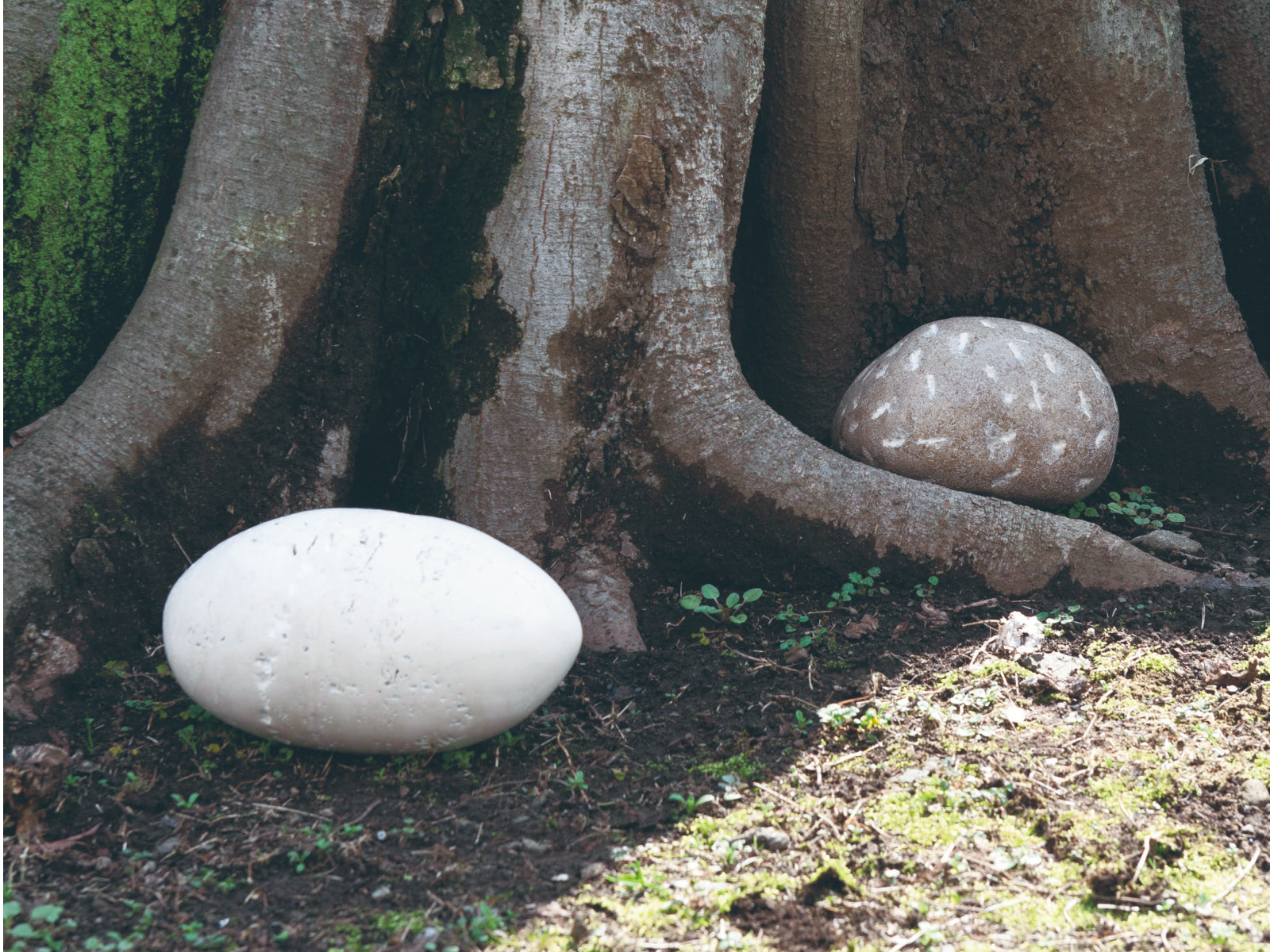
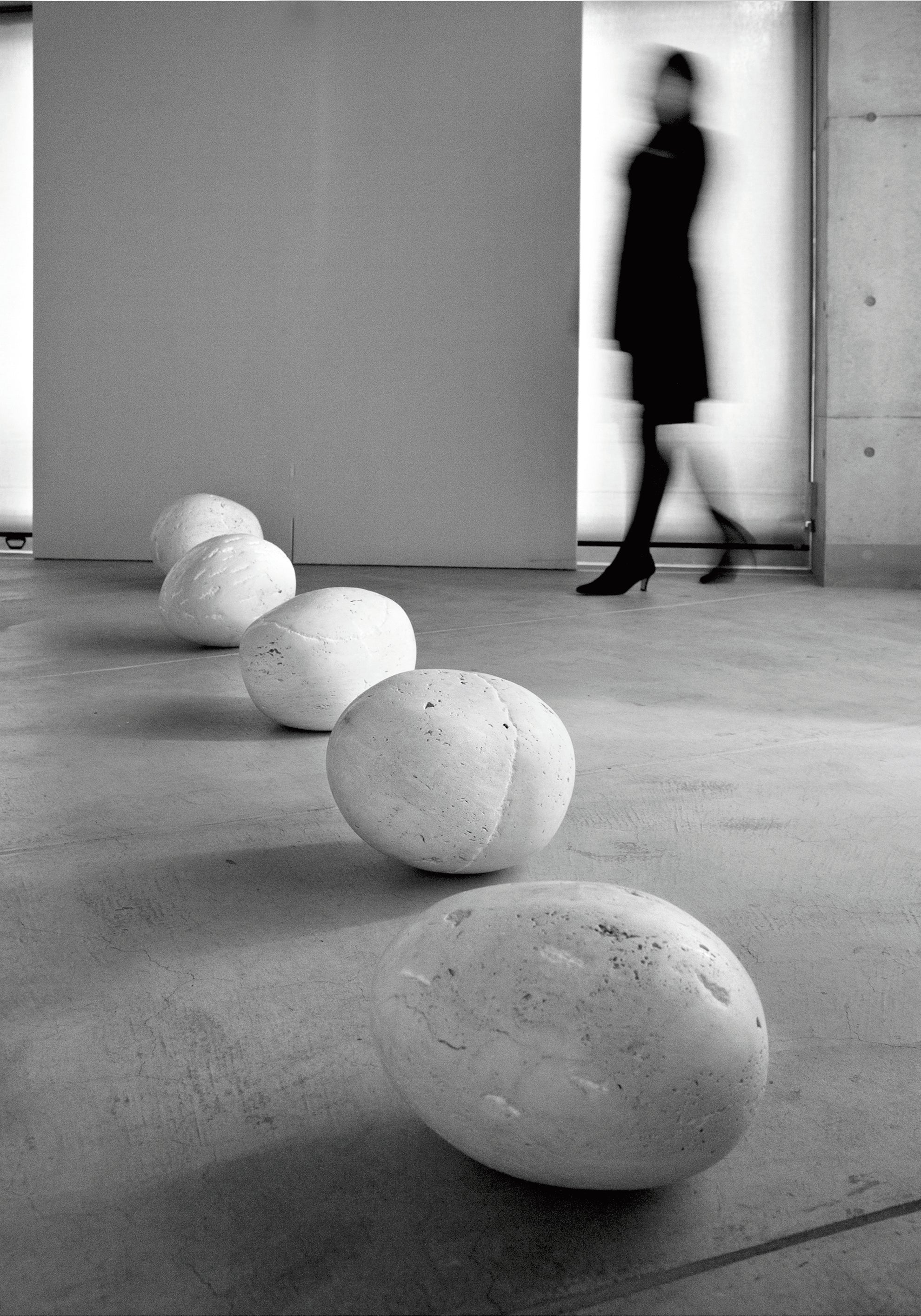
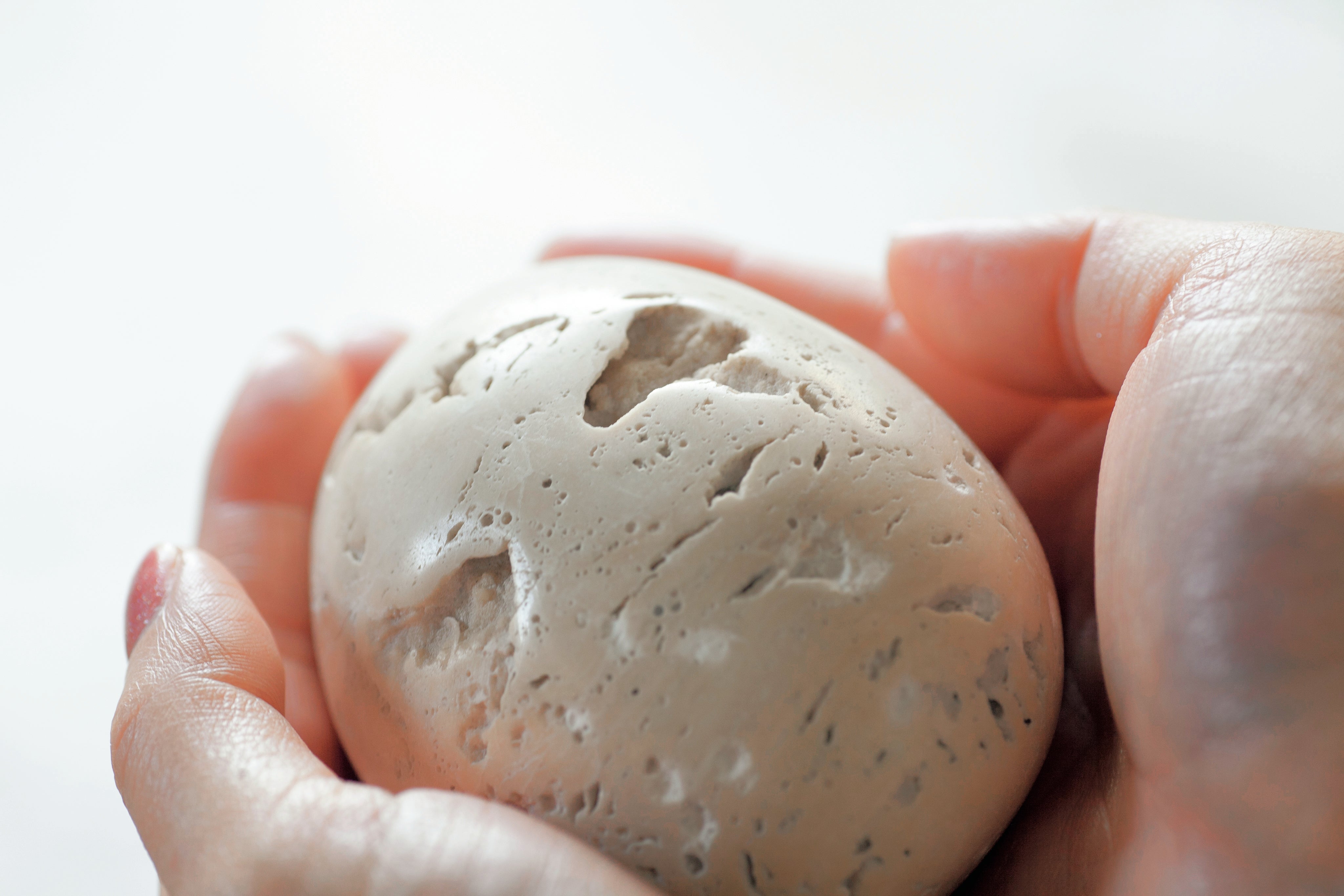
Stone lies within the earth, seeking the light above ground, waiting to be touched by us
Atsuya Tominaga
"It was not form; it was the trace of the chisel."
For Atsuya Tominaga, stone is not something from which to carve a form, but a means of inscribing himself into nature and communing with the stone. Stone is not a material but a partner, and in the place where he and the stone meet, Tominaga's "trace" is born. It is a response to nature, a covenant, carved entirely by his own hands from beginning to end, without a single assistant.
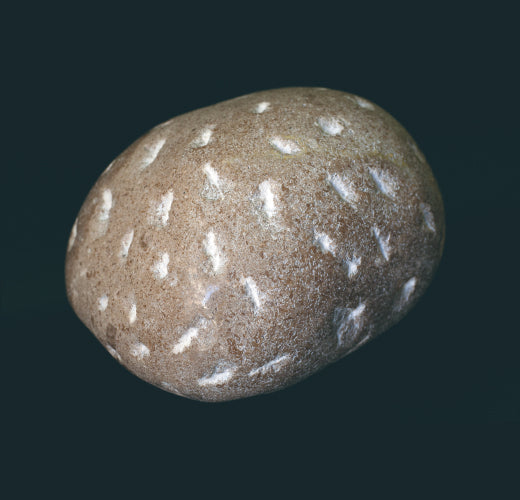
In his exhibition four years ago he presented "Ninguen" (Human), a series of standing figures like stones raised toward the heavens. In this exhibition he presents "Sphere," spherical and cubic works begun in 2011, like stones rolled upon the earth. "The pillar is male and the sphere is female. Together they are one world." Small enough to hold in the palm, shaped like fruits or seeds, with no clear top or bottom, they have an irregular movement that changes expression with the angle of view. The white-toned travertine and marble are streamlined, their corners worn away, and organic.
Just as Richard Long (b. 1945) walked across fields to leave his footprints, and Roger Ackling (b. 1947) gathered sunlight with a magnifying glass to draw by scorching wood, for Tominaga too nature is not something to be conquered. It is a counterpart with which he engages in dialogue. From here his work becomes not a "thing," a finished form, but an "act": the trace of carving and cutting stone.
Born in Osaka in 1961, Tominaga studied sculpture at Kanazawa College of Art and its graduate school, then in 1986 began working in black granite at a quarry in Osaka. At the age of 29, for three months, the sight of the setting sun sent him into panic. Perhaps because he was surrounded by great stones that hold time on a cosmic scale, the sunset assailed him as a terror that hinted at death. Then, one day, the setting sun passed straight through his body. That was the moment Tominaga became one with nature and answered the stone. After ten years of work at the quarry he went to Pietrasanta, Italy, for a year of work, but what struck him decisively for all his later work were the catacombs he saw beneath a church in Rome. It was a space of stone lined with niches for laying the dead to rest, and when he saw the chisel marks on its surface, he perceived the meaning of the primal human act of carving stone. "It was not form; it was the trace of the chisel."
These two episodes, in Japan and in Italy, each speak of Tominaga's work: when the setting sun passed through him, the outer and inner worlds became the same and nature became one with his own body; and through the revelation he received in the catacombs, sculpture became not a matter of form but a "trace" in which he inscribes himself. Thereafter, using travertine, he made the "Ninguen" series of standing figures that recall ancient stone columns. In 1998 he set up a studio in the mountains of Kyoto, and later carved, on site, limestone of the same kind as the cave walls of Lascaux in France.
As a haiku poet composes verses along the road, he carves the stones of the places he visits, the stone of Nachi in Kumano, Wakayama, stone unearthed in the heart of Tokyo, and since 2011 he has travelled the coastline of Tohoku, struck by the great earthquake, carving nameless memorials for the repose of souls in the stones of its rubble. This, too, is an Eastern sensibility in harmony with nature, like the Zen monk Enku carving wooden Jizo figures wherever he walked.
"A surface carved or cut by human hands is clearly different from a surface weathered by nature. For me, to carve stone is to sing the joy of being human."
Stone is the earth; stone was humankind's first tool; people piled stones to build pyramids, raised temples, and shaped the human body in marble. Our relationship with stone has run through the whole course of human creation. But in the modern age, a society transformed by the industrial revolution and the advance of science has taken from us our relationship with stone. Communication has become digital, and media that can send information anywhere at any time have robbed art of its weight and its locality. Today, when we ask the meaning of the "act" by which one person leaves a trace on one stone, there stands Tominaga, simply and steadfastly swinging his hammer at the stone. The stones he brings forth pierce the viewer's heart like lightning. They become a cry in which the pain and the joy of being human are mingled, and they purify the viewer in catharsis. The trace of Atsuya Tominaga is a vivid scene in which nature and the self strike sparks, and a testimony that binds nature and humankind.
Ippodo Gallery New York
Shoko Aono
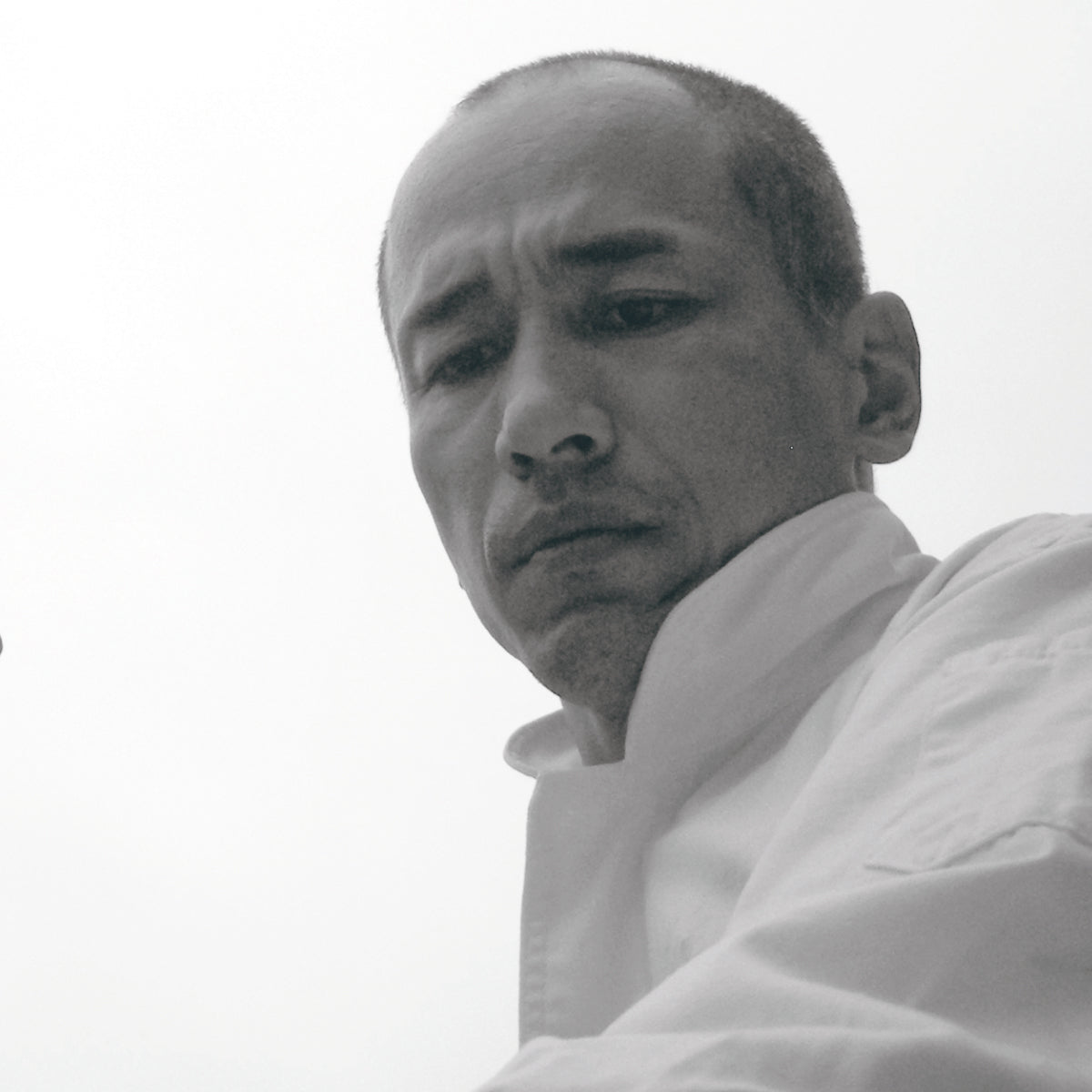
Atsuya Tominaga
Atsuya Tominaga
Born in Osaka in 1961.
1984
Graduated from Kanazawa College of Art, Faculty of Art and Craft, Department of Fine Art, Sculpture Course
1986
Completed graduate studies at Kanazawa College of Art
1988
Awarded in the Osaka Nakanoshima Green Road sculpture competition
1997–98
Stayed and worked in Italy on an overseas study grant from the Pola Art Foundation
Selected solo exhibitions at Ippodo
1994 Atagoyama Gallery
1997 Zakurozaka Gallery
2002 Ginza Ippodo Salon
2008 Ippodo N.Y. (USA)